
Ha, how’s that for a cryptic title to a blog post? All it asks in Mandarin is, “Do you have WeChat?” Yes, we do, but can we use it? As an opening anecdote, not long ago I was on WeChat talking with a Chinese businessman, and I inadvertently mentioned something related to cryptocurrency. I was told that we could not discuss that on WeChat. Crypto is illegal in China, and merely mentioning the topic might trigger issues. Hmmm!
To be clear, I don’t speak a word of Mandarin or any other Chinese dialect, but I have close business ties with Chinese entrepreneurs. I have discussed the content of this blog informally with them, and we recognize and acknowledge the limitations of the WeChat/Weixin brand outside of China.
As an overview, WeChat/Weixin, is a subsidiary of Tencent Holdings, Ltd., a massive Chinese, multinational technology company whose stock is primarily traded on the Hong Kong stock exchange. It is not traded on U.S. exchanges, but its shares can be acquired OTC by jumping through a few administrative hoops. The Motley Fool provides guidance here.

Image Source: Google Finance
The core of Tencent’s financial success is its WeChat/Weixin platform that has achieved meteoric growth since its inception as a texting app in 2011; 300M active users by 2014 and 1.3B active users (mostly in China) at the end of 2023. Of note, there are less than 10M users outside of China, and most of that usage is communication with the mainland because the bulk of WeChat/Weixin’s commercial components are fundamentally China-centric. Thus, the moniker WeChat is generally thought of as a calling app, while in China users are on Weixin for the full array of its services.

Image Source: Adobe
From a product development perspective, WeChat/Weixin started by taking a deep dive into understanding its market and the prospective audience it intended to serve. That market and user base is primarily Chinese, although the developers had closely observed the functionality of U.S. social media, messaging, and Ecommerce apps. For context, in 2011 when the app was launched, no American social media platforms had been authorized for use in China. Thus, the product developers saw an opportunity to fill the void by building a social networking platform that was easy to join and use, comprehensive as to content and connectivity so that users would not have to leave the platform, and it was to be inherently Chinese, i.e., sensitive to Chinese culture and traditions. The goal was to make WeChat/Weixin an essential part of users’ lifestyles for communications, gaming, Ecommerce, and fintech services. WeChat/Weixin became a near inescapable part of its users’ daily existence. It even has a built-in browser, so that users can search without leaving the platform Pretty cool, right? But could there be a downside?

Image Source: Adobe
Let’s look at a somewhat troublesome aspect of WeChat/Weixin’s great success. It is no secret that, despite protestations to the contrary, all WeChat/Weixin servers are accessed and monitored by the Chinese equivalent of the U.S. National Security Agency (NSA). This allows the GOC to have efficient and consolidated access to user activity by surveilling, profiling, and (in China) social scoring. It’s no wonder that U.S. federal and state government agencies have expressed concern about the potential exploitation of U.S. user data on sites such as WeChat/Weixin, TikTok and others. Some countries including Canada and India, have actually banned or materially restricted the use of WeChat/Weixin.

Image Source: Adobe
An additional concern regarding WeChat/Weixin is international trademarking. The U.S. Trade Representative has identified WeChat/Weixin as one of the most egregious platforms for the sale of pirated and counterfeit merchandise.

Image Source: Office of the U.S. Trade Representative
In light of the current geopolitical trends and the suspicions clouding the global perception of Chinese surveillance and lax compliance with international patents and trademarking, there are likely to be more restrictions imposed on the use of WeChat/Weixin outside of China. This could result in the future growth of the platform being confined primarily to its usage by consumers in China itself.
Nonetheless, despite concerns about the platform beyond China’s borders, the WeChat/Weixin brand exemplifies the essence of astute and well-conceived social media platforms.

Image Source: Logo Wine
Looking past geopolitics, securities laws, and cultural issues related to WeChat/Weixin, the product is a user friendly and engaging social media networking platform that has done an incredible job at building a highly sticky constituency of users. The platform has immense utility to its community, and there are many colloquial phrases commonly used in China that refer to WeChat/Weixin functions….similar to here in the U.S. when we say, “I googled it,” even if we are using a search engine other than Google.
Concurrently, WeChat/Weixin is culturally attuned to its user base, and its users know and accept that the platform is connected to government surveillance. Presumably, if users are behaving properly, they have nothing to be concerned about. While usage outside of China may raise regulator eyebrows, in China there are 1.3B users who essentially live on WeChat/Weixin’s exemplary social networking platform.

Image Source: Adobe
———————————————————-
For further information, here is a YouTube video puff piece on the journey of WeChat/Weixin from inception to the current day. It includes a fair amount of favorable but transparent spin, while attempting to appear balanced in addressing the issues that have faced and will continue to challenge the company.
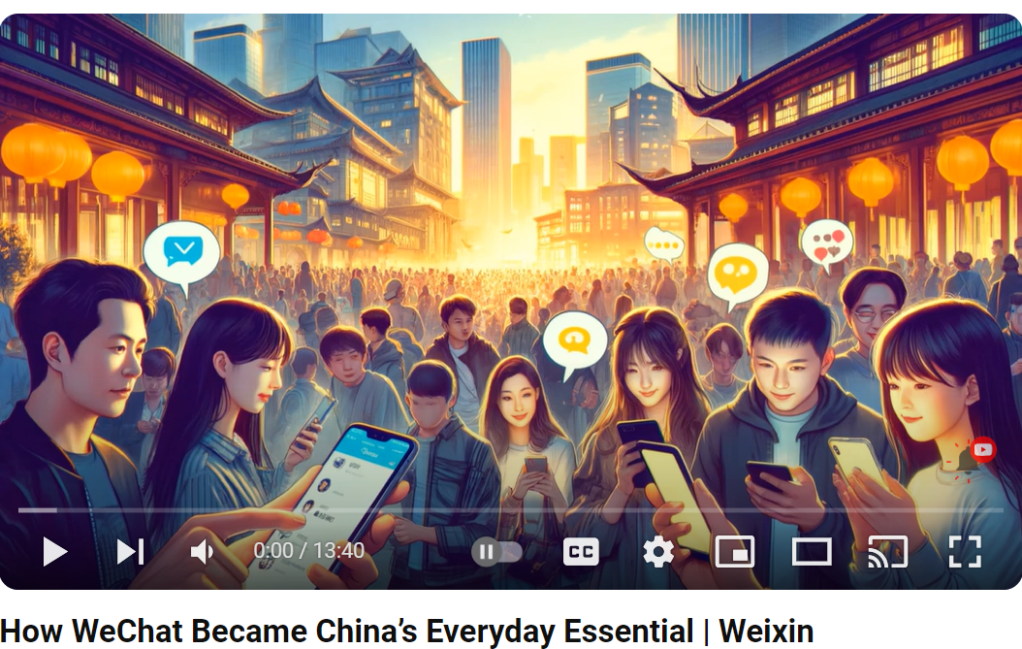
Image Source: YouTube
#snhusmm
 Sand Gnat Sound Bites
Leave a comment